Pro racer Can Akkaya fixes the mental barriers of street and track riding, offering a roadmap to overcome fear and ego for safer, high-performance results.
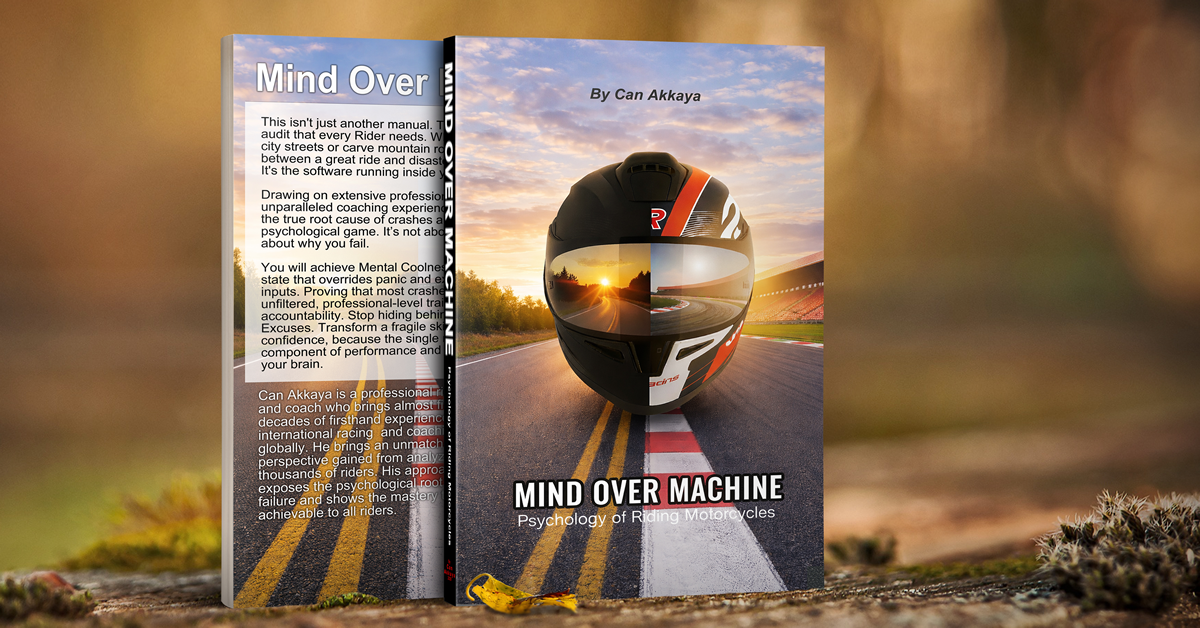
SACRAMENTO, CA, UNITED STATES, March 1, 2026 /EINPresswire.com/ — Former FIM-licensed professional racer and founder of Superbike-Coach Corp, Can Akkaya, has released a tactical autopsy of the motorcycle industry’s failed safety culture in his new work, “Mind Over Machine: Psychology of Riding Motorcycles.” The book marks a definitive departure from traditional literature, shifting the focus from mechanical hardware to the “mental software” of the rider.
While the motorcycle industry has historically prioritized hardware and physical drills, Akkaya argues that mental patterns—specifically fear, ego, and survival instincts—are the primary factors in rider plateaus and accident rates. In “Mind Over Machine,” Akkaya exposes the “uncomfortable truths” within the industry, criticizing a culture that often prioritizes the aesthetic of speed over the reality of psychological competence.
“While mechanical training is essential, it’s only half the story,” says Akkaya. “In my laboratory of thousands of students, I’ve seen that mechanical skills vanish the moment fear or ego takes over. ‘Mind Over Machine’ provides the uncomfortable truths that traditional training often bypasses. It’s written in the raw, unfiltered language of the track because, at the limit, there is no room for sugar-coated theories. This is the psychological framework that finally completes the safety loop.”
Deliberately stripped of academic “fluff” and industry jargon, the book’s narrative reflects the urgency of the track. Akkaya’s “Die Hard Honesty” serves as a necessary disruptor for a community often lulled into a false sense of security by minimal certification standards.
The book serves as the theoretical foundation for the curriculum taught at Superbike-Coach Corp in Northern California. Known for its “Defined Competence” philosophy, the school utilizes physics-based training to override hard-wired survival reactions, such as target fixation and mid-corner panic. “Mind Over Machine” addresses critical industry topics, including:
— THE LOCUS OF CONTROL: Shifting from external excuses to internal accountability in high-risk environments.
— SURVIVAL INSTINCT VS. PHYSICS: Understanding why natural human reactions often conflict with motorcycle dynamics.
— EGO MANAGEMENT: Analyzing the “illusion of speed” and its role in rider error.
A LEGACY OF UNCONVENTIONAL COACHING
The insights found in “Mind Over Machine” are the result of Akkaya’s decades of experience on international racing circuits. Since founding Superbike-Coach Corp, he has become known for a “no-nonsense” instructional style that prioritizes survival over sentimentality. His programs, ranging from specialized Wheelie Schools to Cornering Clinics, serve as a real-world laboratory for the theories presented in the book.
“I see students every week who have the best gear and the fastest bikes, but they are paralyzed by a fear they can’t name,” Akkaya explains. “Or worse, they are blinded by an ego that won’t let them admit they are out of their depth. This book is about stripping that away so the real learning can begin.”
“Mind Over Machine: Psychology of Riding Motorcycles” is available now on Amazon in Paperback, Hardback, and eBook formats.
ABOUT SUPERBIKE-COACH CORP
Superbike-Coach Corp is a premier motorcycle performance coaching organization based in Sacramento, California. Founded by Can Akkaya, the school provides advanced training for street and track riders, focusing on the intersection of human psychology and high-performance vehicle dynamics.
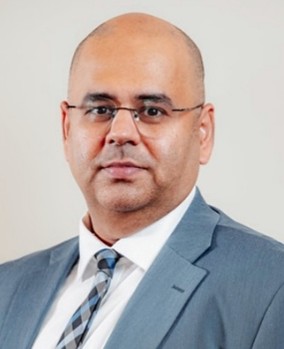
Can Akkaya
Superbike-Coach Corp
email us here
Visit us on social media:
LinkedIn
Instagram
Facebook
YouTube
TikTok
X
Coach Akkaya Tip Best way to Brake on a Motorcycle, presented by BBB, the Better Business Bureau
Legal Disclaimer:
EIN Presswire provides this news content “as is” without warranty of any kind. We do not accept any responsibility or liability
for the accuracy, content, images, videos, licenses, completeness, legality, or reliability of the information contained in this
article. If you have any complaints or copyright issues related to this article, kindly contact the author above.